The File
Notes on Enchanted Forest's zoning history, from its 1985 rezoning to a 2019 request to expand, and what it shows about Oregon's rules for rural land.
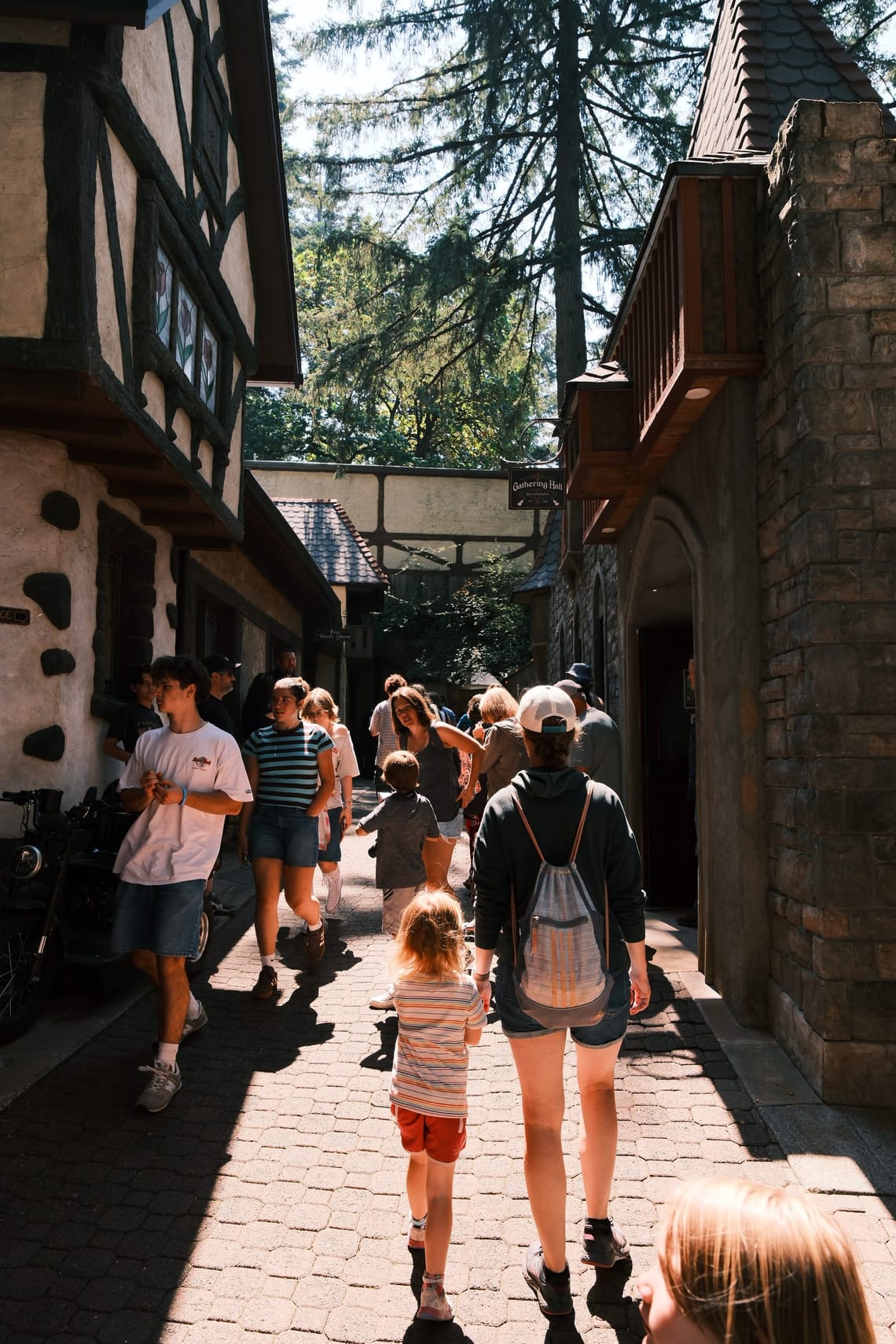
Enchanted Forest is a family-built theme park on a wooded hillside off I-5, just south of Salem. Roger Tofte started building it by hand in 1964 and opened it in 1971. It sits outside any city, on rural land, which in Oregon means it lives under one of the strictest land use systems in the country. A while ago I wrote about the park and said I wished I could see its planning file. I found part of it. This is about what's in it, and what it says about the rules Oregon uses to decide what gets built in the countryside and what doesn't.
In that first post, Idiot Hill, I pictured a cardboard box in a county basement, stuffed with fifty years of correspondence. Inspections, additions, a change of use. Somewhere in there, I figured, a public employee had to classify the giant shoe.
I didn't find the box. I found a PDF. It is twenty-nine pages long, and it is not about the giant shoe. It is about seven acres of woods next door.
In 2018, Tofte Family LLC asked Marion County to rezone 7.15 acres of a neighboring parcel from rural residential to commercial so the park could grow onto it someday. A hearings officer held a public hearing in February 2019 and recommended approval that May. The Board of Commissioners held its own hearing in July, and that October it took up an ordinance granting the request.
To understand why seven acres took twenty-nine pages, it helps to know how Oregon works. In 1973 the state passed a law that eventually produced nineteen statewide planning goals, and every city and county has to plan by them. The best known idea is the urban growth boundary, a line drawn around each city. Inside the line, you build. Outside it, the land is meant to stay farms, forests and genuinely rural places, and Goal 14 exists largely to keep city-type activity from leaking out into the country. Enchanted Forest is outside every one of those lines.
That is why the 2019 file reads the way it does. Each statewide goal gets its turn, and most of them politely excuse themselves. Agricultural lands, not applicable. Forest lands, not applicable. Beaches and dunes, ocean resources and the Willamette River Greenway, not applicable. The park is in the woods off I-5, nowhere near a beach, but the system still has to ask. Goal 14 is the one that matters, and the county had to show that a bigger theme park would not turn the countryside into something urban.
What surprised me was what the file already knew about the original park, or really what it didn't need to know.
There was probably never an application for the first Enchanted Forest, at least not one that looked like this. Roger opened before the statewide system was finished, and Marion County did not adopt its comprehensive plan until 1980. When the county went through the countryside sorting farm and forest land from everything else, the park was already there. The county asked the state for an exception, a pocket of land excused from the farm and forest rules because it was already developed. On the map of something called the Sunnyside-Turner Interchange exception area, Enchanted Forest is a darkened square. The system showed up, found a castle on a hillside, and drew a line around it.
The paperwork caught up in 1985, when the park was rezoned commercial so it could expand. The county didn't want every commercial use on a wooded hill near people's houses, so it attached a short list of the only things allowed. The list reads like a summer in 1955. Auditorium. Miniature golf course. Motion picture theater. Penny arcade. Circus. Shooting gallery. Pony riding ring (no stable).
I keep coming back to that parenthetical. Somebody, at some point, cared enough about the smell, or the flies, or a neighbor, to make sure the ponies could work there but not sleep there. I don't know who. I would like to.
In 2004 the county rewrote its rural zones to line up better with Goal 14, and those old commercial categories disappeared. So in 2019, when the family wanted the same kind of list for the new land, the hearings officer had to translate a pony ring into a federal Standard Industrial Classification code. He took "official notice" of the SIC manual and put a printout of Major Group 79, Amusement and Recreation Services, into the record.
So I was wrong about the shoe. Nobody classified the shoe. They classified the whole park, more than once, and the second time it took a federal manual.
The other thing I didn't expect was the trees. In Idiot Hill I wrote about how the hillside hides whatever is fifty feet ahead, and how that makes a small park feel bigger. I meant it as a design observation. In 2019, the family's attorney made the same observation as evidence. He sent the county a Google aerial photo and pointed out that the park is essentially unseen from above. A theme park nobody can see from the sky, the argument went, still looks rural. The hearings officer agreed and suggested keeping it that way with a vegetation buffer and setbacks. In a system built to keep the countryside looking like countryside, Roger's trees have been doing legal work for forty years.
Even the overflow parking got this treatment. In 2007 the county approved about five acres for a lot so visitors would stop parking on the shoulder of Enchanted Way. It can only be used from 8:30 in the morning to 8 at night, March through September, and never after dark. Even the parking lot has a bedtime.
I want to be fair to everyone in that file, because I know what the government side of the counter feels like. Notices went out. A hearing was held. One member of the public testified. The engineers asked for stormwater detention and proof of state highway approval. The hearings officer asked the family to say which uses it actually wanted instead of guessing for them. I would have done the same thing.
So is the system too strict? I go back and forth. Oregon's rules are a big part of why you can drive from Portland to Eugene and still see farms instead of one long strip mall. They protect some of the best soil in the world, and they've held up under real pressure. An hour north of Enchanted Forest, the state has spent the last few years fighting over farmland outside Hillsboro. In 2024 the governor proposed using temporary new powers to bring 373 acres into Hillsboro's growth boundary for the semiconductor industry, and then decided not to. In 2026 a bill would have done roughly the same thing, and its sponsor dropped it after farmers, residents and land use groups pushed back. That land is close to home for me, so I'll stick to what's on the public record. But even with Intel and federal chip money in the conversation, the line held. One of the groups that fought hardest in Hillsboro, 1000 Friends of Oregon, also shows up on the mailing list for the Enchanted Forest case. They read everything.
That's the part that makes me uneasy in a different way. The system is not soft on big companies and hard on families. It is hard on almost everyone, and it is very good at saying no to things that don't fit a category. A chip fab at least has a category. So does a parking lot. A man carrying cement into the woods to build a fairy tale does not. Enchanted Forest exists mostly because it got there first.
Roger once said he didn't think they could have built the park under modern conditions, because the red tape would have cost too much. After reading this, I believe him.
Near the end of the file is a site plan. Most of it is the usual stuff, property lines and contours and acreage. Over the new land, someone has drawn a loose outline and labeled it Proposed Expansion Area. Underneath, it says the area could include various rides and buildings.
That's all it says. No rides are named. Nothing is drawn inside the line.
Roger was almost ninety when that sketch went into the record. I don't know whose hand drew it. I like to think he had something in mind for that empty space, one more thing he wanted to make, and that the line was just the county asking him where.
Sources
- Marion County Board of Commissioners, agenda packet for Case ZC/CP/PLA 18-007 (Tofte Family LLC), public hearing July 17, 2019, including the hearings officer's recommendation and the applicant's supplemental letter
- Marion County Board session agenda, July 17, 2019
- Marion County Board session agenda, October 16, 2019
- Marion County Case 06-05, Tofte Family LLC (2007)
- Oregon's Statewide Land Use Planning Goals, DLCD
- OPB, December 27, 2024
- OPB, March 4, 2026
- 1000 Friends of Oregon, 2026 Legislative Recap
Loading Bluesky discussion…